


Key Takeaways
- State Regulations Determine the Available Routes: Cosmetology licenses are issued at the state level, not nationally. Some states recognize regulated apprenticeships, while others require applicants to graduate from a state-approved school.
- Salon Training Usually Takes More Hours: Georgia requires 3,000 apprentice hours compared with 1,500 school hours. California requires apprentices to complete at least 3,200 on-the-job hours and 220 hours of related training, compared with 1,000 hours for its school-based cosmetology route.
- Exam Performance Can Vary: California records have shown lower written-exam pass rates for cosmetology apprentices than for school-trained applicants in certain reporting periods. These results vary by period, examination, license type, and candidate group and should not be treated as national averages.
- Interstate Licensing Can Be Complicated: Completing an apprenticeship does not automatically prevent you from obtaining a license in another state. However, the destination board may consider your license status, training records, examination history, and professional experience.
- Online Courses Cannot Replace Practical Training: Some approved programs offer theory instruction online, but remote coursework alone does not satisfy the supervised, hands-on training required for initial cosmetology licensure.
Beginning a career in hair, skin, or nail care can be exciting, but the cost and schedule of traditional beauty school may feel intimidating. Tuition at some private beauty schools exceeds $15,000, while program length can range from several months to more than a year, depending on state requirements, attendance, and weekly schedules.
It is understandable that prospective students look for faster or more affordable alternatives. If you are wondering whether you can legally avoid traditional beauty school, the answer depends on the state where you intend to work, the training routes recognized by its licensing board, and the responsibilities attached to each option.
Is Beauty School Always Required?
The United States does not have one nationwide cosmetology license. Each state establishes its own rules governing the services cosmetologists may provide, the amount and type of training required, the examinations applicants must pass, and whether an apprenticeship may replace a school program.
Before selecting a training route, review the applicable cosmetology licensing requirements by state. The requirements of the state where you plan to become licensed determine whether your education makes you eligible for its licensing process.
Completing an approved school program remains the standard route in most states. Some states also recognize formally registered apprenticeships completed under licensed professionals. These alternatives are not available everywhere, and their permitted occupations, training hours, registration procedures, and supervision rules differ substantially.
Georgia and Arkansas demonstrate how different state requirements can be:
- Georgia: The Georgia State Board of Cosmetology and Barbers requires a school-based cosmetology course to include 1,500 hours completed over at least nine months. Georgia also permits a Master Cosmetologist apprentice to complete 3,000 hours over a minimum of 18 months under the state’s official apprenticeship rules.
- Arkansas: Applicants using Arkansas’s standard initial-license route must complete 1,500 hours in a licensed cosmetology school. Current licensing information from the Arkansas Department of Health Cosmetology Section does not provide a salon-apprenticeship replacement for those school hours.
Therefore, earning a cosmetology license without attending a conventional school does not mean avoiding education or supervision. Where apprenticeships are recognized, candidates complete their required preparation in another regulated environment.
What Cosmetology Apprenticeship Training Involves
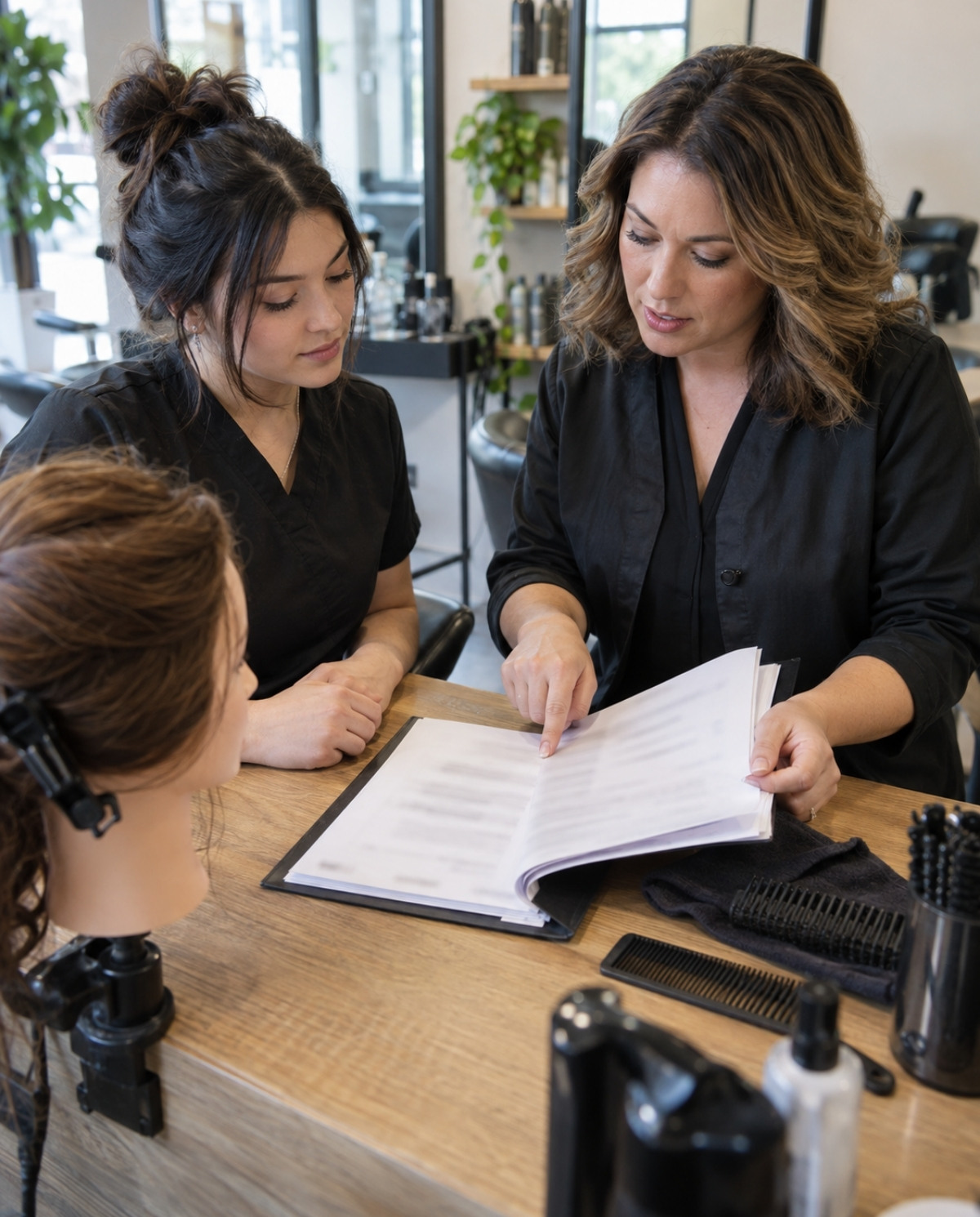
A cosmetology apprenticeship is one of the primary alternatives to a school-based program. Rather than spending most training hours in classrooms and student clinics, apprentices learn through supervised work in an approved salon.
A legitimate apprenticeship is not simply an ordinary salon position. The apprentice, supervising professional, establishment, and sometimes a separate sponsor may require approval before training begins. Hours accumulated before an apprentice is properly registered or licensed may not be accepted by the state board.
Apprenticeship requirements also include more than working with salon clients. The California Board of Barbering and Cosmetology, for example, requires apprentices to complete at least 3,200 hours of on-the-job training over two years. Cosmetology apprentices must also receive at least 220 hours of related training through their program sponsor.
Advantages of Training in an Active Salon
Daily exposure to a working salon is one of the main advantages of apprenticeship training. Apprentices can observe client consultations, appointment management, product recommendations, and the methods professionals use to organize services throughout the day.
Working around paying clients can help apprentices strengthen their communication abilities and develop a practical understanding of service timing. Depending on the program and state requirements, they may gradually perform authorized services under the required level of supervision.
A registered apprenticeship ordinarily combines compensated employment, structured workplace training, and related instruction. The U.S. Department of Labor describes registered apprenticeship as a model that includes paid on-the-job training with classroom instruction. Specific wages, schedules, expenses, and benefits still depend on the sponsor, employer, and applicable laws.
This arrangement may allow an apprentice to continue earning income while preparing for licensure. It can also create opportunities to form professional relationships within the local beauty industry.
Potential Drawbacks and Training Gaps
The quality of salon training depends greatly on the program’s structure, sponsor, and supervising professional. Technical talent does not automatically make someone an effective instructor, and a busy salon may not provide lessons as regularly as a structured school schedule.
Apprentices should also avoid assuming that every salon duty qualifies as approved training. Preparing supplies, cleaning stations, and observing other professionals may be normal workplace responsibilities, but state boards generally require documented instruction across designated subjects and services.
Theory education deserves particular attention. Future cosmetologists must understand infection control, client safety, product use, hair and scalp conditions, chemical procedures, basic skin and nail care, and the laws that regulate their work. A reliable sponsor should clearly explain how these subjects will be taught and how apprentices will prepare for their licensing examinations.
Before enrolling in an apprenticeship, ask:
- Do the apprentice, salon, and supervisor need state approval before training starts?
- Who maintains the hour records, and when are they reported?
- What happens to recorded hours if the supervisor leaves or the establishment closes?
- Can completed hours be moved to another approved salon or program?
- How does the program teach theory, sanitation, chemical safety, and state law?
- Are textbooks, formal classes, and examination preparation included?
- Which wages, instructional charges, registration fees, equipment expenses, and examination fees apply?
- How much of the weekly schedule is assigned to approved training activities?
These questions are important because states may restrict how training hours are combined or transferred. Georgia does not permit apprentice hours to be combined with school hours. It also requires a new application whenever an apprentice changes supervising professionals or salons before more hours can be credited.
Understanding Apprenticeship Exam Statistics
Official records suggest that some apprentices have experienced greater difficulty with written licensing examinations, but limited reporting data should be interpreted cautiously.
In one collection of California Board apprenticeship meeting materials, cosmetology apprentices recorded a lower written-exam pass rate than candidates from school programs during the period analyzed. Results differed across reporting periods, examination categories, license types, languages, and candidate populations.
Those figures do not establish a fixed California pass rate or a nationwide apprenticeship average. They also cannot prove that a particular subject, teaching method, or knowledge gap caused the difference. The statistics identify different outcomes without explaining exactly why those outcomes occurred.
Prospective apprentices can ask sponsors for recent program-level pass rates, candidate totals, and clarification about whether the results represent first attempts or all examination attempts. Our guide to cosmetology state board exam preparation provides additional information about written testing, practical requirements, kits, and study planning.
Can Online Cosmetology Courses Lead to Licensure?
Students balancing employment, childcare, or other responsibilities may be especially interested in remote learning. Online classes can add flexibility to an approved program, but they do not create a complete licensing route by themselves.
Subjects That May Be Offered Remotely
Certain state-approved schools use hybrid formats that deliver part of the theory curriculum online. Depending on state authorization, remote subjects may include anatomy, infection control, chemistry, product knowledge, business practices, and state regulations.
Online participation does not guarantee that the completed hours will be accepted for licensure. Distance education must be included within a program recognized by the relevant licensing authority. Schools may also need to document attendance, participation, assignments, assessments, and completed hours.
Confirm the following with both the school and state board before enrolling:
- The institution is approved by the state licensing authority.
- The specific cosmetology program leads to eligibility for licensure.
- The state permits the advertised theory instruction to be completed online.
- The curriculum includes all mandatory supervised practical training.
- The program satisfies the rules of the state where you intend to apply.
Practical Skills That Remote Study Cannot Substitute
Cosmetology is a hands-on profession. Students and apprentices require supervised experience with sanitation, client protection, tools, haircutting, styling, chemical applications, and the other services contained within their state’s cosmetology scope.
An online certificate alone is not a cosmetology license and does not prove that the holder completed an approved initial-licensure program. Practical training must take place through a school, apprenticeship, or another pathway formally recognized by the appropriate licensing authority.
Online beauty education is not automatically illegitimate. Many courses provide useful continuing education, product instruction, business knowledge, or examination preparation. The concern arises when a provider claims that an inexpensive online certificate, without approved practical training, legally authorizes someone to provide regulated cosmetology services.
Before paying a provider, contact the state board and verify whether that exact course or program satisfies initial licensing requirements.
Comparing the Time Required for Each Route

People looking for the quickest licensing option may assume that an apprenticeship saves time because salon employment begins immediately. Starting an apprenticeship, however, is different from qualifying as a fully licensed cosmetologist.
Full-time school is often more direct because the schedule is specifically organized around completing approved hours. Depending on state requirements and weekly attendance, a full-time cosmetology course may take approximately 8 to 15 months. Part-time attendance generally takes longer, while absences, holidays, closures, scheduling changes, and transfer problems can delay graduation.
Our cosmetology school timeline guide explains how required training hours may translate into weeks or months under different schedules.
Apprenticeships frequently require more total hours and may impose a minimum calendar period. Georgia requires 3,000 apprentice hours over at least 18 months. California requires at least 3,200 on-the-job hours over two years plus 220 related-training hours.
School is not necessarily faster in every individual situation. A part-time student could take longer than an apprentice following a consistent work schedule. Nevertheless, someone able to attend school full time may reach examination eligibility through a more direct timeline.
What Apprenticeship Means for Interstate Licensing
Moving after becoming licensed can create additional complications. The United States has no universal reciprocity system, and state boards use terms such as endorsement, reciprocity, transfer, and examination in different ways.
Completing apprenticeship training does not automatically prevent someone from receiving a license elsewhere. Depending on its regulations, the destination board may consider:
- Whether the current license is active and free of disciplinary restrictions;
- The amount and type of training completed;
- The licensing examinations previously passed;
- The applicant’s history of licensed professional experience;
- Whether the original licensing standards are considered substantially equivalent;
- Whether additional training or a state-law examination is necessary.
Some boards emphasize licensed work experience, while others compare the applicant’s original training with their own educational requirements. Apprentices should retain copies of registrations, curricula, hour reports, related-instruction records, examination results, licenses, and employment documentation.
The Cosmetology Licensure Compact is intended to simplify practice across participating states. However, the official Compact website currently states that multistate licenses are not yet being issued.
Once the system becomes operational, applicants are expected to need an active, unencumbered single-state license from the compact state in which they reside and must satisfy the applicable application conditions. Member states retain authority over their own education, training-hour, and competency-examination requirements. The Compact does not create one national hour requirement or restrict eligibility exclusively to school-trained applicants.
If relocation is likely, examine the destination state’s current endorsement rules before committing to either pathway. Neither school nor apprenticeship training guarantees automatic acceptance in every jurisdiction.
Comparing the Complete Financial Commitment

Cost is a major reason prospective cosmetologists explore alternatives to school. An apprenticeship may lower tuition expenses and provide paid employment, but participants can still face training-related costs.
Depending on the program, expenses may include:
- State registration and permit charges;
- Required related instruction;
- Books and digital learning resources;
- Tools, products, clothing, and safety equipment;
- Examination and initial-license fees;
- Transportation, childcare, and other daily expenses;
- Additional education required after changing programs or relocating.
Request a written explanation of wages, fees, required equipment, weekly schedules, instructional obligations, and refund conditions before entering an apprenticeship agreement. Confirm how employment status and compensation will be handled.
School expenses can include tuition, application or registration charges, student kits, textbooks, and living costs during training. Eligible students attending qualifying programs at participating schools may be able to receive federal student aid.
Accreditation alone does not guarantee Pell Grants or federal loans. The institution and program must satisfy federal eligibility requirements, the school must participate in the relevant aid programs, and the student must qualify individually.
Prospective students can consult the official Federal Student Aid school search and ask the institution’s financial-aid office to confirm whether a particular program is eligible.
A standalone salon apprenticeship generally does not provide Pell Grants or federal student loans in the same manner as an eligible college or career-school program. Other possibilities may include employer assistance, workforce funding, veterans’ benefits, scholarships, or support connected to a separate education provider.
Compare the complete financial impact rather than tuition alone:
- Total tuition or related-instruction charges;
- Books, tools, uniforms, registrations, examinations, and licensing costs;
- Expected earnings during apprenticeship training;
- Transportation and childcare expenses;
- The estimated time required to become licensed;
- Available grants, scholarships, benefits, or workforce assistance;
- Possible expenses associated with moving or completing extra training.
Finding the Training Option That Fits You
The right route depends on state law, personal circumstances, career plans, and preferred learning environment.
An approved beauty school may suit students seeking a defined curriculum, scheduled theory classes, consistent instructor access, organized examination preparation, and a potentially shorter full-time route.
An apprenticeship may suit individuals whose state recognizes salon training, who have located an approved and dependable sponsor, and who need to earn income while learning. Prospective apprentices should still understand the longer hour requirements, reporting duties, related instruction, and possible complications caused by changing salons or moving.
Whatever route you choose, confirm its approval directly with the state licensing authority before paying or beginning training. Statements from a salon, school, mentor, or online provider cannot replace official licensing requirements.
Frequently Asked Questions
May an ITIN Be Used Instead of an SSN?
Requirements depend on the state. The California Board of Barbering and Cosmetology, for example, accepts a valid Individual Taxpayer Identification Number instead of a Social Security Number on licensing applications.
An ITIN is issued for federal tax administration and does not independently provide immigration status or authorization to work. Applicants should verify their employment eligibility separately and confirm the current identification rules with their state board.
Will a Criminal History Automatically Prevent Licensure?
Not necessarily. Requirements vary by jurisdiction and offense. The Texas Department of Licensing and Regulation, for example, reviews convictions individually and may consider the nature of the conviction and how long ago it occurred.
Texas also allows prospective applicants to request a criminal history evaluation letter before committing to education and examinations. Applicants elsewhere should determine whether their licensing agency offers a similar preliminary review.
Is an Apprenticeship-Based License Transferable?
It may be. Apprenticeship training does not automatically disqualify a license holder from obtaining credentials in another state. The destination board may review the person’s existing license, training documentation, examinations, experience, and disciplinary record.
Additional coursework, professional experience, or testing may be required when the destination state does not consider the existing qualifications equivalent.
Can Salon Apprentices Use Federal Student Aid?
A standalone salon apprenticeship generally does not provide Pell Grants or federal student loans in the same way as an eligible college or career-school program. Depending on the arrangement, an apprentice may instead qualify for employer assistance, workforce funding, veterans’ benefits, scholarships, or aid connected to a separate eligible education provider.
Are Apprentices Allowed to Serve Clients?
Where cosmetology apprenticeships are permitted, registered apprentices may generally perform authorized services under the supervision required by the state and program. They may not work independently or disregard restrictions governing the approved establishment, trainer, duties, or recordkeeping.
What Should I Do Before Moving to Another Salon?
Procedures vary by state. An apprentice may need to end the existing arrangement, obtain an official transcript of completed hours, submit new registration documents, and receive approval for a new salon or supervisor before accumulating additional hours.
Contact the state board before changing establishments and retain official copies of all training records.
Explore Structured Cosmetology Training
If you prefer scheduled theory instruction, supervised clinic experience, and guidance while preparing for the licensing process, a school-based program may fit your goals.
Dalton Institute of Esthetics and Cosmetology offers a 1,500-hour Master Cosmetologist program designed around Georgia’s education requirements. Its published program information includes hands-on learning, salon-business education, client-retention training, résumé development, and job-seeking skills.
Visit the Dalton Institute Enrollment page to review admission requirements and begin exploring available programs. You may also submit the contact form below to connect with the school and request current information about schedules, costs, financial aid, and upcoming enrollment opportunities.