The Ultimate Nail Tech Skills Checklist: Essential Core Procedures and Professional Tools

Transitioning from a beauty hobbyist to a professional is about more than just painting pretty designs. In 2026, the industry is increasingly focused on nail technology procedures that prioritize structural integrity and chemical safety. When I see beginners struggling with their first sets, it is usually because they are missing the foundational motor skills and technical knowledge that separate an enthusiast from a licensed expert.

The modern landscape has shifted toward a more medical-grade approach to manicuring. If you are still deciding how to start your professional journey, looking at this beginner guide to launch your professional journey can help you decide which path fits your goals. Data from Business Research Insights suggests that nearly a third of clients now deal with chemical sensitivities, which means there is a huge demand for technicians who understand the science behind the products they use.

Key Takeaways

  • Market Trends: The sector is on track to become a $122.7 billion industry by 2035, with a massive push toward skin-safe and clinical-grade services in 2026.
  • Legal Requirements: Under the latest MoCRA guidelines, you need to understand product chemistry to stay compliant with FDA safety and recall standards.
  • Modern Skills: The current gold standard in the industry focuses on precision e-filing and the use of Builder-in-a-Bottle (BIAB) systems.
  • Clinical Science: Using bioactive ingredients like calcium silicate has been shown to boost nail thickness by 39%, turning the technician into a true health consultant.

The 2026 Starter Kit Checklist

I know that the initial investment and the time required to get licensed can feel like a lot to take in. To help you plan your budget and your education, I suggest reviewing the certificate vs license requirements so you have a clear roadmap. Once you are ready to put together your nail technology kit, I find it helpful to group your items into four specific categories:
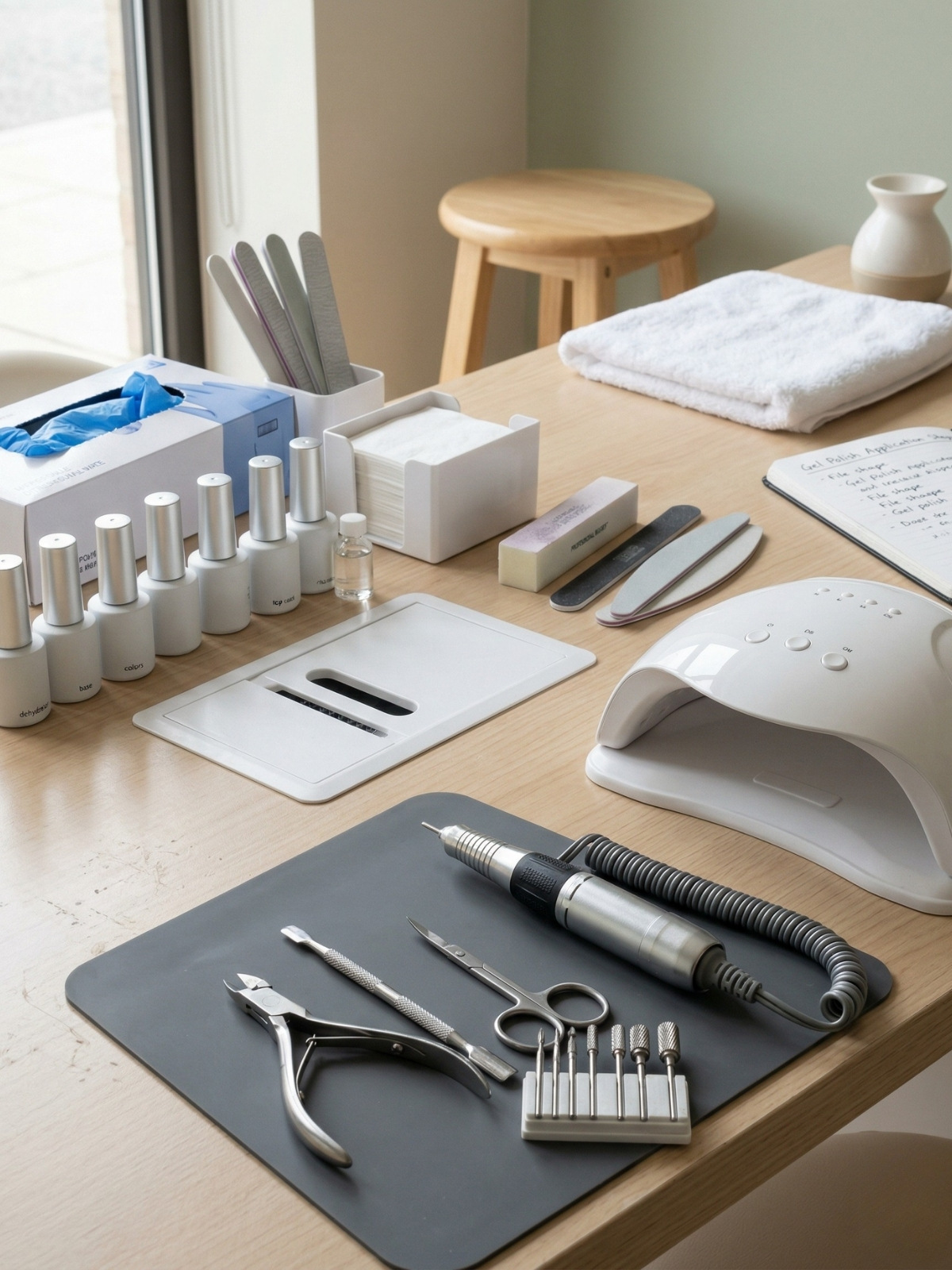
A detailed view of an organized professional nail technician workstation featuring an e-file, cuticle nippers, nail files, a white UV/LED lamp, gel polish bottles, and a training notebook.

  1. Equipment: These are your permanent investments, such as high-torque E-files and professional UV/LED lamps.
  2. Implements: Your reusable steel items, including pushers and nippers.
  3. Materials: The everyday consumables like lint-free wipes, buffers, and files.
  4. Professional Products: The actual chemistry you work with, from dehydrators and primers to structured gels.

When I’m asked what do beginner nail techs need, I always emphasize that things for nail techs should include safety gear. A HEPA-filtered dust extraction system is a non-negotiable nail technology tools requirement in 2026 if you want to protect your health over a long career.

The Architecture of Professional Tools

One of the most common mistakes I see is spending too much on trendy colors while ignoring the high-quality tools that actually do the hard work. When we look at what nail techs use, we have to separate your daily operating supplies from your long-term capital investments.

Defining “Permanent Items” in the Salon

In a professional setting, you might hear the question: what are permanent items utilized in nail technology known as? These are officially classified as Equipment and Multi-use Implements.

Unlike disposable items, these represent your long-term business overhead. High-quality stainless steel nippers and 48W+ UV/LED lamps are the true infrastructure of your station. I always recommend buying autoclave-ready steel to ensure you can meet the high clinical sanitation standards required today.

Hygiene and Professionalism

Modern sanitation is about more than just a quick soak. High-performance tools like the salmon hygiene technology nail brush have become standard because their bristles are built to resist bacterial growth while providing a deep clean. Using these types of technology-backed tools is a great way to show your clients that their safety is your top priority.

The Regulatory Shift (MoCRA 2026)

According to the latest FDA MoCRA updates, knowing your brands is now a legal requirement. In 2026, the FDA has the authority to issue mandatory recalls. If the products used in nail technology at your station are linked to health issues, they can be removed immediately. This makes your education in product chemistry a vital part of your professional legal standing.

The Geometry of Structural Mastery

Advanced Procedures: Building the Apex

In 2026, a top-tier technician is expected to create extensions that are strong but look natural. This requires a deep understanding of the C-curve and the Apex, which are the foundations of all nail technology procedures.

  • The C-curve is the arch you see when looking at the nail from the front. A proper curve provides the structural strength needed to keep the nail from being too flat and brittle.
  • The Apex is the highest point of the enhancement when viewed from the side. This is the stress point of the nail. By placing your product correctly here, you ensure the extension can handle daily use without cracking.

The Secret to Custom Extensions: Nail Forms

Learning how to put nail form templates on correctly is one of the most important skills a student can master. I prefer these over plastic tips because they allow you to create a custom extension based on the actual shape of the client’s finger. If you want to know how do you put on a nail form for the best results, you have to ensure it sits flush against the skin to prevent the structural gaps that lead to breaks.
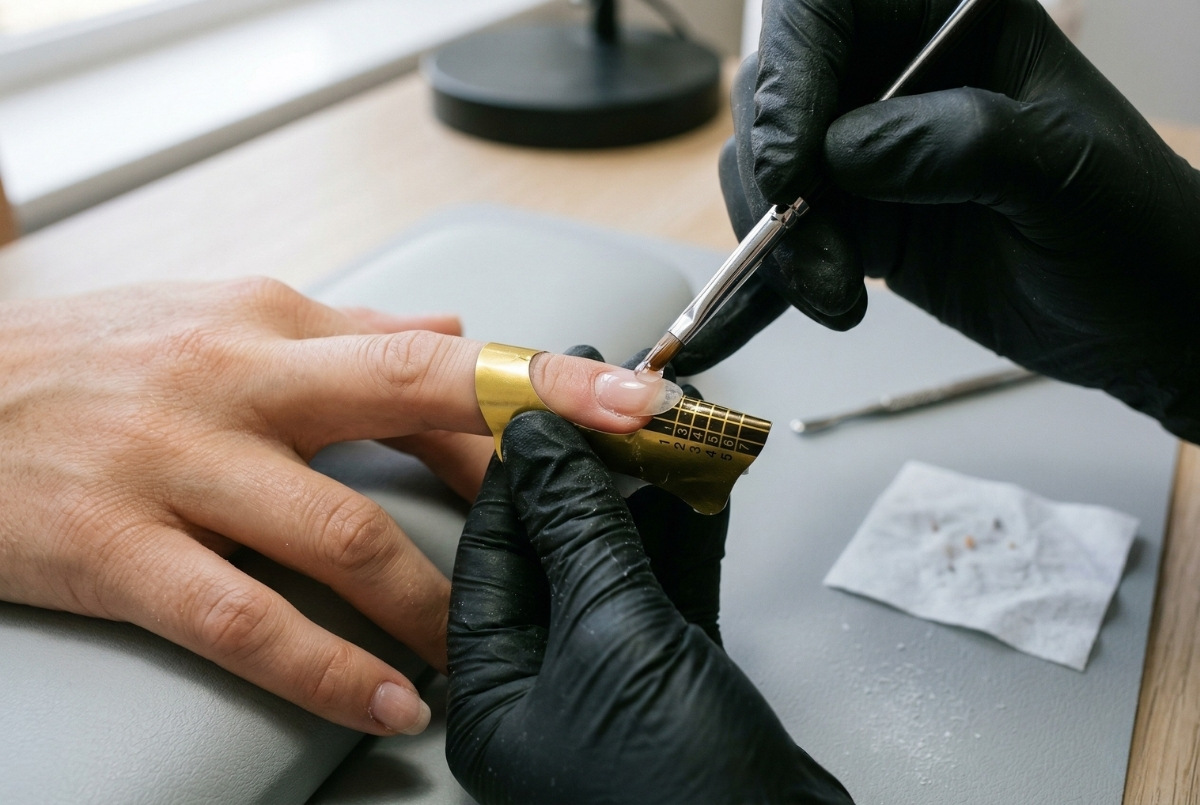
Close up view of a nail technician in black gloves applying clear builder gel over a gold form template.

Using Structured Gels

Once your form is in place, your choice of material matters. Many professionals now prefer products like DIVA nail technology builder gel or other BIAB systems. These structured manicures are very popular because they protect the nail’s lipid barrier while being extremely durable. As noted in recent industry reports, these services often allow you to charge 20-30% more because of the value they provide to the client.

Precision Tech and Bioactive Care

Mastery of the E-File

The e-file is often misunderstood as a “drill,” but in a professional nail technology kit, it is a precision instrument. When you learn how to use an e nail, you are actually performing micro-exfoliation. Using high-quality diamond bits at low speeds allows you to clean up non-living tissue with incredible accuracy, which helps your gel applications last much longer.

The Science of Healthy Nails

We are currently in a skin-first era of beauty. This means we prioritize the health of the nail plate and the surrounding skin over just the aesthetic look. I have seen great results with systems like OPI Nail Envy with Tri-Flex Technology. This product uses a triple-layer reinforcement that mimics the natural keratin structure of the nail.

By understanding how OPI Nail Envy original strengthener with triflex technology and nail matrix technology treatments support the growth center of the nail, you can help clients recover from damage. This kind of expertise is what allows you to transition from a service provider to a true nail health consultant.

The Evolution of Press-Ons

Don’t confuse professional sets with cheap alternatives. In 2026, press-on nail technology is used to create custom, hand-painted gel sets for high-end clients. Knowing what are nail press-ons in a professional context allows you to build a brand and earn income even when you aren’t physically in the salon.

Expert Insight: Clinical Data

A 2025 clinical study in MDPI showed that bioactive formulas with calcium silicate can increase nail strength by 64% in less than a month. When you can explain the science behind the nail technology products you choose, your value as a professional skyrockets.

A friendly nail technician reviews nail health with a client across a clean wooden table in a bright salon.

Aftercare and Professional Growth

Your service isn’t finished once the top coat is cured. The most successful technicians always provide detailed after care advice for nail technology to their clients. Educating them on how to manage mechanical stress – like not using their nails as tools – ensures your work stays perfect and leads to the positive reviews that grow your business.

The global market is expanding rapidly and is expected to hit $122.7 billion by 2035. However, the industry is splitting between budget salons and high-end specialists. By mastering these nail tools and uses early on, you are positioning yourself for the most profitable side of the market.

Ready to Start Your Career?

The shift toward clinical beauty and bioactive health is a huge opportunity for new specialists. At Dalton Institute, we focus on a salon-ready philosophy to ensure you are prepared for the real world from day one. You will work with the same nail technology tools and professional products used in nail technology that are required by the best boutiques in the industry.

If you are ready to see where your career can take you, I invite you to find out more in Enrollment. You can also reach out to us through the contact form we leave at the end of this article to schedule a tour or get your questions answered. We look forward to helping you build your future.

FAQ: Navigating Professional Tools

What tools do you need to do nails at a professional level?
Professional tools used in nail technology require more power and precision than what you usually find for home use. In school, you will learn to use high-torque e-files and LED lamps with specific outputs to prevent allergies caused by uncured gel.

What do nail techs use to ensure their kits are high quality?
I always recommend focusing on system consistency. This means using the base, color, and top coat from the same brand to ensure the chemicals bond correctly. It is the best way to prevent peeling and lifting.

What are the 4 types of nail technology tools beginners should know?
Generally, a professional nail technology products list is broken down into Equipment, Multi-use Implements, Materials (disposables), and Professional Chemical Products.

What tools do you need to be a nail technician in a medical-grade setting?
You will need specialized nail technology tools like an autoclave for sterilization, medical-grade bits for your e-file, and a kit filled with hypoallergenic products to protect your clients from sensitivities.


Certificate vs. License: What You Really Need to Launch Your Nail Career

I’ve noticed a lot of talented artists lately who can create stunning sets right from their own homes. It is an exciting time to be in the beauty industry, but as 2026 rolls around, the path to turning that talent into a legitimate business is becoming a bit more structured. Artistry is a huge part of the job, but having a strong legal foundation is what really makes a career unshakeable. Before you start planning your professional pivot, it is worth looking at a beginner guide to launch your professional journey to get some perspective on how the industry looks this year.

Key Takeaways for 2026

  • Licensure vs. Education: While you might earn a nail technician certificate during your studies, you actually need a state-issued license to legally accept payment for services.
  • Client Expectations: Modern data shows that about 22% of clients now prioritize technicians who have verified medical-grade sanitation credentials.
  • Transparent Pricing: At Dalton Institute, the nail technician training program is priced at $8,500 total, which covers your education without hidden surprises.
  • New Safety Laws: The 2026 enforcement of MoCRA means that knowing your chemistry and product safety is now a federal expectation.

A tidy home nail workstation with professional manicure tools, an open study notebook, and gel polish bottles on a wooden desk in a bright, sunlit room.

The Legal Reality: Why a Certificate Alone Isn’t Enough

One of the most frequent points of confusion I see involves the difference between a school diploma and the actual permit you need to work in a salon.

Education Milestones vs. Permission to Practice

When people ask if they can do nails with a certificate, the answer really depends on their goals. You can certainly use a certificate in nail technology to show you’ve completed a course or a workshop, but it doesn’t grant you the legal right to work in a commercial setting. To do that, you need a nail technology license from your state’s Board of Cosmetology.

Your certificate proves you did the work and learned the skills, but the license proves you are compliant with the state health codes. If you attend a state approved nail technician program, you also benefit from the Interstate Cosmetology Compact. In 2026, this initiative is making it much easier for licensed professionals to move and work across different states without having to start their testing from scratch.

The Impact of MoCRA in 2026

The industry shifted quite a bit this year because of the Modernization of Cosmetics Regulation Act (MoCRA). According to the U.S. Food & Drug Administration, there is now more oversight regarding the chemicals used in professional-grade products. This means that being a pro in 2026 isn’t just about the art; it’s about being a safety expert who understands chemical volatility. If you practice without a license, you are actually taking on much higher federal liability than in previous years.

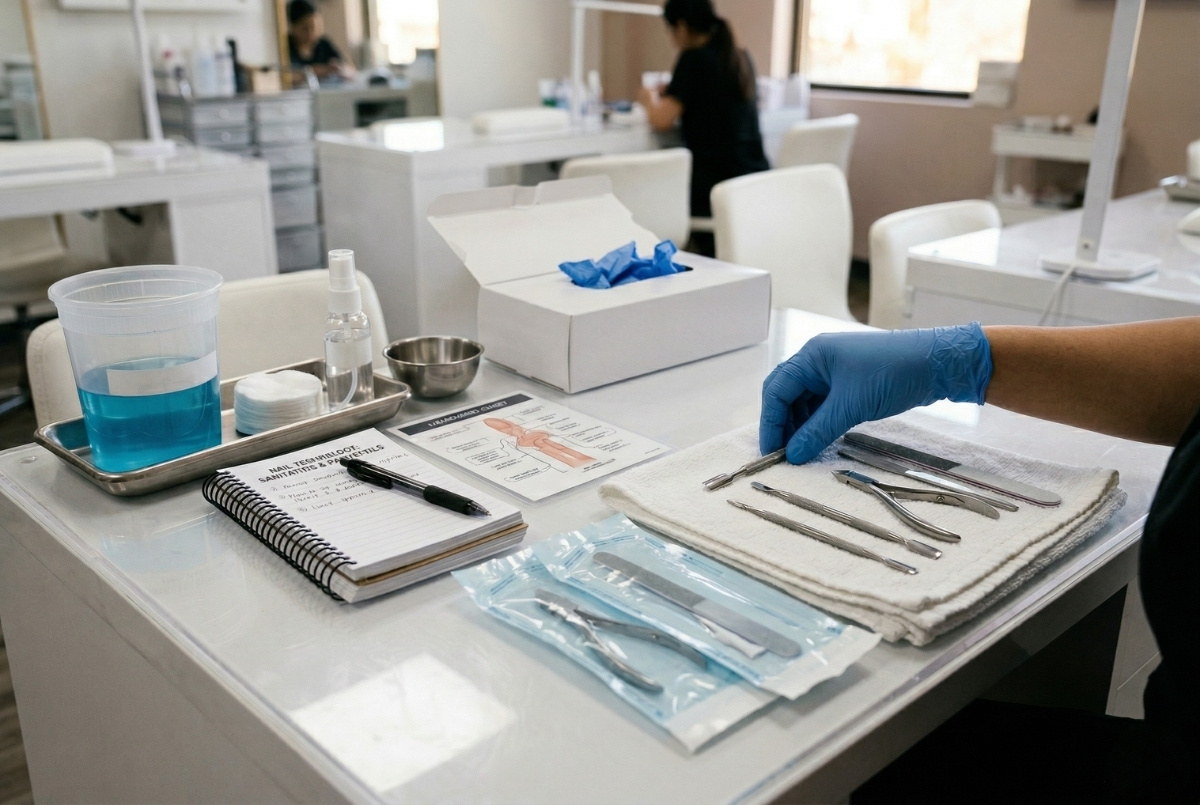
A close-up photograph of a nail technician in blue gloves organizing sterilized metal manicure tools on a white towel, featuring sealed sterilization pouches, study materials, and a disinfecting setup on a clean acrylic workstation.

The Education Path: Clock Hours and Preparation

Deciding on a nail technology program is a big step for your future business. I always recommend that you break down the real differences between nail programs and cosmetology before you sign up, just to make sure the curriculum fits your specific goals.

Training Hours and Experience

If you’re wondering how long is a nail program, most states in 2026 require between 300 and 600 hours of training. For those looking to finish quickly, you can often complete a nail tech program in about 3 months if you go full-time. If you have other commitments, a part-time manicuring school schedule might take closer to 6 months.

I sometimes hear people mention a nail technician apprenticeship as an alternative. While some states allow this, it usually takes twice as long as traditional school. Plus, you might miss out on the structured nail technology training program theory—like learning how to handle blood exposure or understanding the lipid barrier—that is vital for passing your exams.

The State Board Exam

To get your license, you have to pass the final nail technology exam. I’ve found that the best schools now use AI-driven nail technology state board practice tests. These tools are great because they mimic the 2026 exam format, helping you focus on sanitation and chemical safety so you aren’t overwhelmed on the day of the actual test.

A young nail technician student focused on a workbook at a modern manicure station with professional tools in a bright, airy beauty academy.

Planning Your Financial Investment

I know that the nail technician certificate cost and tuition can feel like a lot to handle upfront. However, it is better to look at the total cost of attendance so you aren’t surprised by extra fees later.

Understanding the Total Cost

When you are looking at how much is nail technology school, remember to check if the price includes your tools. At Dalton Institute, we aim for total transparency with a total investment of $8,500. This is designed as a complete package that includes:

  • Professional instruction to guide you through the requirements for nail technology.
  • A high-quality student kit with the same tools used by working professionals.
  • Your books, registration fees, and access to our modern learning portals.

Knowing your nail program cost upfront helps you plan your budget without worrying about hidden expenses for kits or graduation fees halfway through.

Finding Support and Funding

There are actually quite a few ways to make your nail technology classes more affordable in 2026:

  • Workforce Pell Grants: The Department of Education is expanding aid for short-term career training through the Workforce Pell framework starting in July 2026. It is worth asking our office how these federal shifts might help you.
  • Industry Scholarships: I often suggest students look into Beauty Changes Lives, which provides various scholarships for nail technology to help reduce the financial burden.
  • Payment Plans: We understand that paying everything at once isn’t always an option. Many students use our flexible internal payment plans to manage their tuition in smaller increments while they study.

The 2026 Earning Potential

The market right now is looking for professionals who can guarantee safety. Recent data from Business Research Insights shows that 22% of customers specifically look for licensed technicians because they want to know the salon is hygienic. This “Safety Premium” is a major part of why licensed pros can charge more.

When we look at what you can earn, Indeed’s data for March 16, 2026 shows a strong upward trend:

  • The national average base pay is around $23.68 per hour.
  • Experienced professionals in the industry can earn base rates over $50.00 per hour.
  • In high-demand luxury markets, some specialized rates have been reported as high as $94.94 per hour.

Remember that these numbers are just the base pay. Your total income usually grows quite a bit when you factor in tips and commissions on the products you use.

Start Building Your Professional Legacy

I believe that the right education is the bridge between having a talent and having a career. At Dalton Institute, we focus on helping you make that transition into the professional world with confidence. We have over 20 years of experience helping students turn their passion into a sustainable business, and we would love to help you do the same.

If you are ready to see our campus for yourself or want to talk through the next steps, you can find more details on our Enrollment page. We also have a contact form at the bottom of this article where you can reach out to us directly. I look forward to helping you map out your new career path.

FAQ: Common Industry Questions

What is the difference between a level 2 nail technology certificate and a level 3 one? A level 2 certificate usually covers the basics of manicuring and standard enhancements. A level 3 nail technician certificate goes deeper into mastery, covering things like advanced electric filing and complex chemical safety.

Can I go to school for nails online? In 2026, many schools offer hybrid nail technology classes where you can do the theory online. However, you still have to complete your hands-on training hours in a physical school to qualify for your state license.

Is the nail technology state board exam difficult? It can be challenging, but if you use a high-quality nail technology state board practice test and stay focused during your training, you will be well-prepared to pass and start your career.

Nail Tech Program vs Cosmetology Program: Breaking Down the Real Differences

Deciding to enter the beauty industry is an exciting turning point, but it often comes with a big question: do you go broad or go deep? Choosing between a cosmetology or nail technician program is really about deciding what kind of daily life you want to lead in the salon. Some people love the variety of doing everything from highlights to pedicures, while others find their calling in the intricate, high-detail world of being a nail technician or nail artist.

In today’s market, being a professional means more than just being good with a brush. It’s about understanding the chemistry of the products you use and keeping your clients safe. Whether you want to be a “Beauty Generalist” who can handle any request or a “Technical Specialist” who masters one craft, your choice of education is the foundation for everything that comes next.

Key Takeaways for Your Career

  • Fast-Track to Licensing: A specialized nail technology program is usually the fastest way to get your license and start your own business, often requiring significantly fewer hours than a full cosmetology course.
  • Strong Industry Growth: The specialized market for nails is expanding rapidly, with reports showing a 10.7% CAGR through 2029, which is actually outpacing many other beauty sectors.
  • Safety and Compliance: Professional training is essential for navigating modern regulations like MoCRA and OSHA standards, ensuring you work safely with professional chemicals.
  • Niche Earning Power: Specializing allows you to position yourself as an expert, which often leads to higher client retention and the ability to charge premium prices for your artistry.

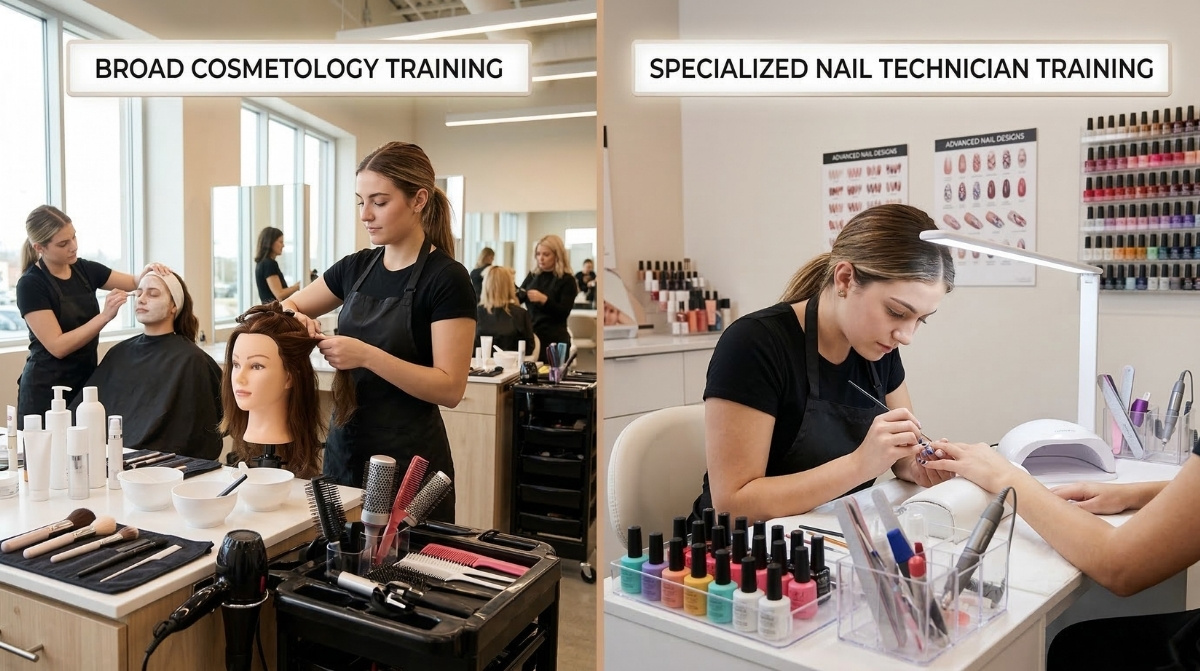
A side-by-side comparison of two beauty career paths in a modern training environment: one side showing a student practicing diverse hair and skincare services, and the other side showing a student performing detailed nail work at a professional manicure station.

Choosing Your Path: The Generalist vs. The Specialist

When you look at the difference between cosmetology and nail technology, it really comes down to the scope of your license. Cosmetology is the most comprehensive path you can take. In Georgia, this requires 1,500 hours of training and covers hair, skin, and nails. I find that this is the best route for people who want total career flexibility. If hair trends change or you want to move into skin care later, a cosmetology license gives you the legal “sovereignty” to pivot your services without going back to school.

On the other hand, a nail technology program is a focused deep-dive into the science of hands and feet. By spending 600 hours on specialized training, you can get through school much faster and start earning sooner. You’ll spend your time mastering nail chemistry, anatomy, and advanced sanitation. If you want to see a detailed breakdown of what this looks like, I recommend checking out this beginner’s guide to launching your nail technology career to see the curriculum steps.

Pro Insight: Navigating 2026 Regulations

Safety is becoming a huge focus for the feds. Under MoCRA, there is more oversight on how cosmetic products are tracked and reported. In the salon, OSHA also requires us to maintain safety data sheets for our products. A high-quality beauty program helps you understand these technicalities so you can run a professional, compliant business from day one.

Defining Your Brand: Identity and Artistry

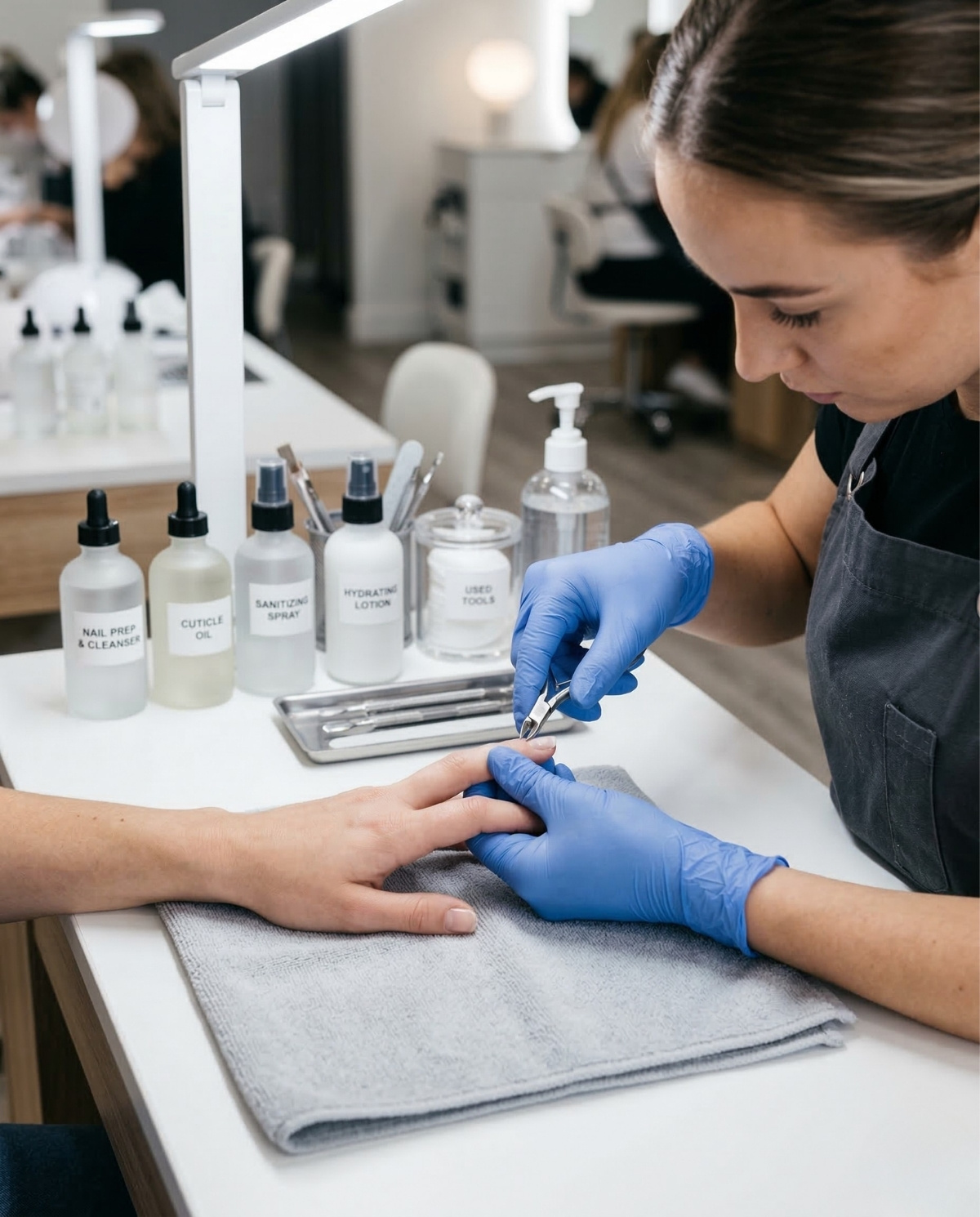
A professional nail training close-up of a beauty student wearing blue nitrile gloves performing a precise manicure at a sanitized workstation with labeled hygiene bottles and sterile implements.

I often talk to people who wonder about the difference between being a nail technician or nail artist. To me, the license is your legal foundation, but your branding is what sets your price point.

In a professional nail tech program, you learn the technical “Why” behind the work – like how to avoid over-filing or how to manage chemical reactions. A technician provides a solid, safe service, but a nail artist uses that technical foundation to create a transformation. In 2026, the most successful pros are those who use their school training to launch specialized niche studios that focus on high-end, artistic results.

For those who lean toward the broader cosmetology path, the career options are massive. There are so many career paths you can pursue with a cosmetology license, ranging from editorial work and film sets to becoming a brand educator for major international lines.

The ROI of Your Time

If you want to get into the workforce as fast as possible, the nail technology program is the clear winner. You can often finish your boards and be working in under six months. This is perfect for entrepreneurs who want to open a salon suite quickly without the time commitment of a year-long program.

However, the career safety net of cosmetology is worth the extra time if you aren’t 100% sure you only want to do nails. While it takes longer to graduate, you are essentially protected against downturns in any specific niche because you can offer so many different services.

Market Insight: The Growth Paradox

The nail sector is seeing a trend called “Premiumization.” According to Technavio’s 2025-2029 Nail Salon Market Report, the specialized nail market is growing at a 10.7% CAGR. I’ve noticed that clients are increasingly looking for specialized boutiques rather than general salons, which is great news if you decide to focus your training.

Wellness and Science in Modern Beauty

A confident nail professional in a beige blazer presents elegant finished nail art to a client in a refined, soft-lit boutique studio, highlighting a luxury beauty career and professional success.

One thing that really separates a pro education from a DIY hobby is the focus on biological integrity. I’ve seen how important it is to understand the physiology of the nail to prevent long-term damage.

Recent industry literature is leaning heavily into wellness-first protocols. For instance, a study in Skin Appendage Disorders showed that specific professional formulations can significantly improve nail hardness. Even newer research from 2025 on Advanced Dry Manicure Techniques suggests that moving away from water soaking can improve product performance and sanitation. Being in a licensed program ensures you are learning these evidence-based techniques.

Which Path Is Right for You?

Choosing between these two programs really depends on your long-term goals.

  • Pick Cosmetology if you want the freedom to work across hair, skin, and nails and want a license that lets you pivot as the market changes.
  • Pick Nail Technology if you have a great eye for detail, love the science of nail chemistry, and want to start your own specialized business in record time.

Ultimately, your success isn’t just about the license you hold, but the level of mastery you bring to your clients every day.

Ready to Start Your Professional Journey?

The beauty industry in 2026 needs more than just workers – it needs professionals who are ready to lead. At Dalton Institute, we focus on making sure you are ready for the reality of the salon from the moment you graduate. We believe in bridging the gap between the classroom and the high-end professional world through mentorship and hands-on experience.

If you are ready to turn your passion into a real career, I invite you to see what makes our approach different. You can find all the details on how to get started on our Enrollment page.

I’d love to help you figure out which program fits your goals best. If you have questions, feel free to fill out the contact form below, and let’s start building your future together.

FAQ: The Professional Reality Check

What happens if I get a Nail Tech license but want to do hair later?
You will likely need to enroll in a full cosmetology program. While some hours might transfer depending on your specific situation, you generally have to complete the hair-specific training from scratch. This is why I recommend the specialist path only if you are certain that nails are your primary passion.

Is the nail tech market too full in 2026?
The demand for high-quality, safe services is actually still growing. The U.S. Bureau of Labor Statistics projects 7% growth for the field through 2034. In my experience, if you offer high-quality work and maintain great client relationships, there is always plenty of room for you to succeed.

Does a cosmetology license let me work in a medical spa?
It’s a great starting point, but med-spa work usually requires additional specialty training or separate certifications depending on the service. For example, in Georgia, certain cosmetic laser procedures are regulated by the Georgia Composite Medical Board. Always check your local laws for specific med-spa roles.

Manicuring vs. Nail Technology: Beginner Guide to Launch Your Professional Journey

It feels like every time I open my feed lately, I see a new level of artistry that makes me realize just how much the beauty world has evolved. If you have been spending your free time practicing intricate designs or perfecting a clean look on your own nails, you might be wondering if that passion can actually turn into a career. In 2026, the industry is in a very different place than it was even a few years ago. It has moved beyond a simple service and has become a specialized field that blends chemistry with high-end personal care.

When I look at what it means to be a professional today, it is clear that we are doing much more than just applying color. This guide is meant to help you understand the landscape of the industry as it stands right now, helping you bridge the gap between being a hobbyist and becoming a licensed specialist.

Key Takeaways for Future Professionals

  • Market Growth: The field is expected to see a 7% increase through 2034, earning it a bright outlook status because it is one of the few roles AI cannot easily replace.
  • Salary Potential: In high-end markets, specialists are seeing rates that range from $34 to $94 per hour.
  • Safety Standards: Current regulations have pushed the industry toward TPO-free and HEMA-free products, making a solid understanding of toxicology a must-have for any pro.

The Technical Evolution: Where Chemistry Meets Care

To really grasp what it means to work in nail technology today, you have to look past the polish. I like to think of modern techs as surface chemists. Every service involves managing polymerization, a chemical reaction that happens right on the nail plate. Knowing how UV light interacts with photoinitiators to create a bond without hurting the skin is what separates a true pro from an amateur.

Professional Scope: What are nail techs in 2026?

I often tell people to think of nail techs as the primary care providers for hands. Beyond the art, your job involves spotting subtle health issues. A professional can tell the difference between a simple bruise and something more serious like subungual melanoma, or know when a client actually needs a medical referral for a fungal infection. You are the first line of defense for hand health, which is why getting your license is so important for public safety.

Expert Insight: The Toxicology Shift

According to recent updates on the New Rules of Nail Care from StyleSpeak, the global ban on certain chemicals has really changed the game. A modern education doesn’t just show you how to apply product; it teaches you how to read a Safety Data Sheet to make sure you are using biocompatible formulas that keep you and your clients safe.

If you want to dive deeper into these technical details, guides like HONA’s Knowledge Hub can help you master the chemistry side of things before you even start your first day in a salon.

Navigation & Economic Reality: Choosing Your Path

There is often some confusion about the difference between manicuring vs nail technology. In most places, your manicuring license is your legal green light to work for pay. However, your training in nail technology is what gives you a competitive edge. While a manicurist handles basic maintenance, a nail technologist is more like an engineer, building structures that prevent trauma to the natural nail.

Practical Success: Nail technology for beginners

If you are looking into nail technology for beginners, I suggest focusing on ergonomic longevity. I’ve seen many talented artists leave the industry within a few years because of neck strain or carpal tunnel. A professional program will teach you the biomechanics of your own body, like how to properly hold an e-file, so you can enjoy a 30-year career rather than burning out in three.

Income Tiers: Manicuring and nail technology salary

Data from the U.S. Bureau of Labor Statistics shows that this is a bright outlook career with about 24,800 job openings every year. Because this work requires high manual dexterity, it’s very resistant to automation.

When you look at the manicuring and nail technology salary, recent trends from Indeed show that specialized techs are the ones making the most. Those focusing on medical manicuring or architectural enhancements can reach six-figure potentials in busy areas.

The 2026 Visionary Landscape: The “Quiet Luxury” Revolution

The big trend for 2026 is soft minimalism. As Vogue Scandinavia reported, the color of the year is a milky white called Cloud Dancer. This trend is all about clinical-grade health and perfect natural nails rather than over-the-top art.

Integration of AR and Digital Consultation

Tech is also becoming a huge partner in the salon. According to SNS Chairs, the market for nail printing and AR devices is exploding. High-end salons now use augmented reality to show clients exactly how a look will turn out before they even start filing.

Ready to Master Your Craft? Your Future at Dalton Institute

If you’re ready to move from the kitchen table to a professional setting, I encourage you to see what’s possible. You want a foundation that prepares you for the reality of a modern salon, where you learn the architectural skills and business knowledge that clients are looking for right now.

You can find out more about how to get started on our Enrollment page. Have questions about the schedule or the campus? We’d love to help you figure out your next steps. Just fill out the contact form below, and someone from our team will reach out to chat!

Frequently Asked Questions

Can I practice medical manicuring with a standard license?
Your license covers cosmetic services. To work in a medical capacity, you would usually need to pursue an advanced nail technician certification that focuses on aseptic techniques for high-risk clients.

How long does a typical program take to complete?
It depends on your schedule, but most students finish their training in about 4 to 6 months. It’s designed to get you into the workforce as quickly and safely as possible.

Is the 2026 market too saturated?
While the basic market is busy, there is actually a shortage of specialists who understand toxicology and clean beauty. Clients are actively looking for pros who prioritize health over speed.

What is the soft minimalism trend?
It’s a shift toward perfect shaping and architectural balance. It’s less about painting a complex picture and more about sculpting the hand to look its best naturally.