

Nail Technician Desk & Station Setup: What You Need for a Safe, Efficient Workspace
Key Takeaways
- Protect Your Body: Nail professionals face meaningful ergonomic risks from repetitive hand movements and prolonged forward-leaning positions. In a study involving 80 female nail technicians, 63.8% reported neck pain, highlighting the value of adjustable seating, better client-hand positioning, supportive padding, and frequent changes in posture.
- Control Airborne Exposure: N95 respirators can filter certain airborne particles but do not protect against hazardous chemical gases or vapors. Proper source-capture ventilation remains essential, and Georgia's adopted mechanical code requires manicure and pedicure stations to exhaust at least 50 CFM per station.
- Organize for Efficient Service: Keeping frequently used equipment within a comfortable reach and arranging tools around your actual service sequence can limit unnecessary reaching, cord interference, and repeated equipment repositioning.
- Budget Beyond Weekly Rent: Booth rental estimates can range broadly from approximately $100 to $500 per week, but independent technicians may also need to account for products, insurance, payment-processing fees, software, marketing, taxes, licensing, and other operating expenses.
- Verify Your Licensing Path: Nail training requirements differ by state and licensing route. Georgia's complete nail care curriculum totals 525 hours, while Arkansas school regulations prescribe a 600-hour manicure curriculum, so prospective professionals should always confirm current requirements with the appropriate licensing authority.
Creating an attractive nail workspace is only part of building a successful professional setup. Your furniture, equipment placement, sanitation system, and ventilation can directly affect how comfortably and efficiently you work throughout the day. As you move from practicing techniques to serving paying clients, a thoughtfully planned station can help reduce physical strain, maintain cleaner workflows, and keep business operations easier to manage. Whether you are researching your path toward professional licensing or reviewing our guide to understanding certificates, licenses, and the requirements for starting a nail career, your workspace should support both professional safety and long-term business goals.
Build a Workstation That Supports Your Body and Your Services
Your nail station becomes the center of nearly every client appointment. Since technicians can spend extended periods seated across from clients, choosing a table and chair should involve much more than selecting furniture that simply looks attractive.
Adjust the Workspace to Fit You
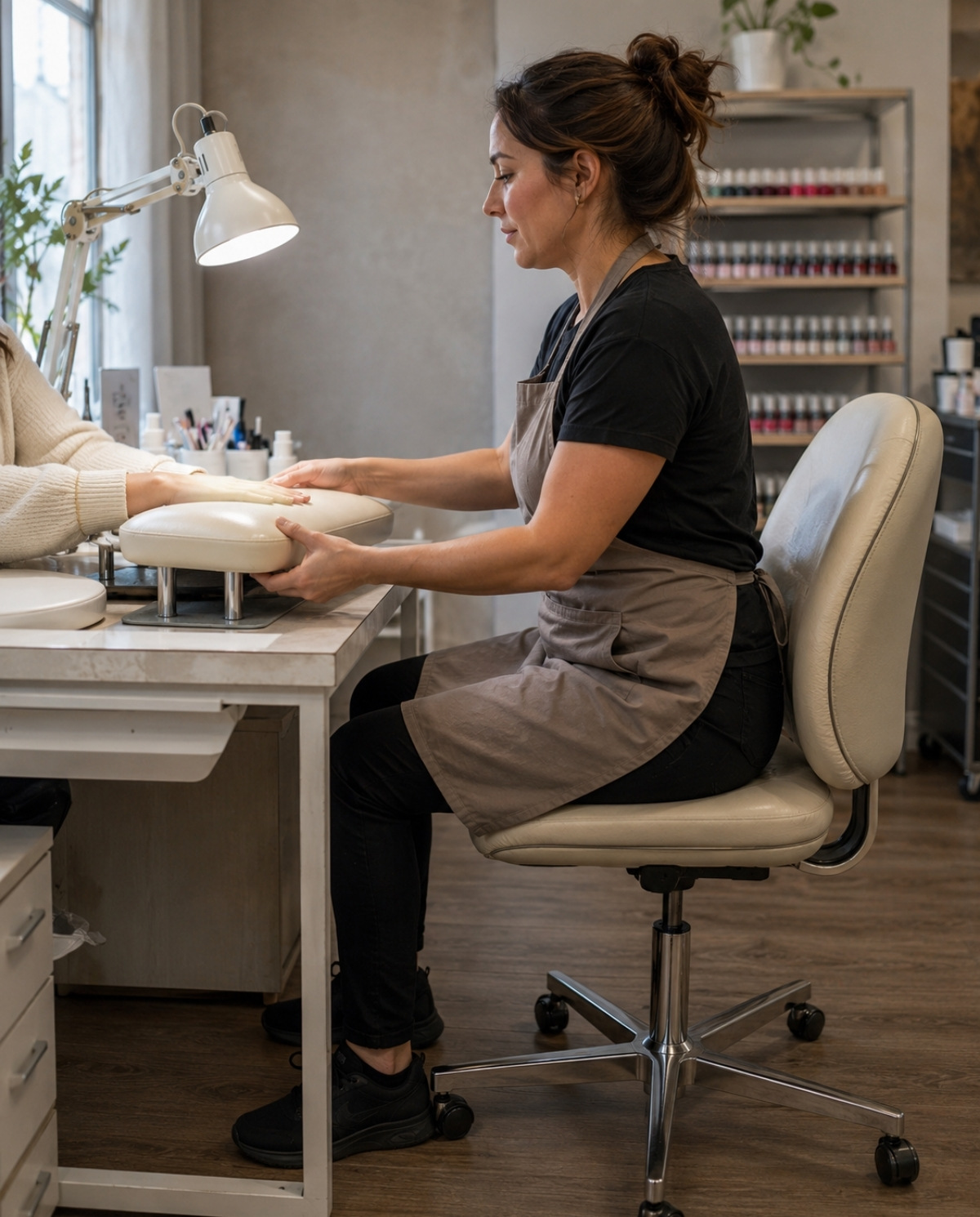
Instead of searching for one supposedly perfect table height, create a setup that can be adjusted around your own posture and working position. The Occupational Safety and Health Administration's nail salon ergonomics guidance recommends an adjustable chair with appropriate back support, proper foot support, positioning the client's hand or foot so excessive forward bending is unnecessary, and using sufficient lighting to see detailed work without repeatedly leaning toward the service area. Padding beneath the client's arm or at points where your wrists and forearms contact hard surfaces can also help reduce pressure during lengthy appointments.
Nail services often involve repetitive, precise hand movements combined with sustained seated postures. Frequent filing, prolonged leaning, and pressure against hard table edges can place stress on muscles, joints, tendons, and nerves. A 2022 occupational ergonomics study involving 80 female nail technicians reported neck pain among 63.8% of participants, the highest prevalence among the body regions evaluated. The research does not mean every technician will develop the same symptoms or experience them within a predictable period, but it does demonstrate that musculoskeletal discomfort is an important occupational concern in nail work.
Adjustable furniture alone cannot eliminate these risks. OSHA also recommends moving the client's hand or foot closer to your natural working position, cushioning areas where the body contacts hard surfaces, taking short breaks when practical, changing positions throughout the workday, and stretching between appointments. Creating several small ergonomic improvements can reduce unnecessary strain more effectively than relying on one piece of specialized furniture.
Select Tables and Storage That Match Your Routine
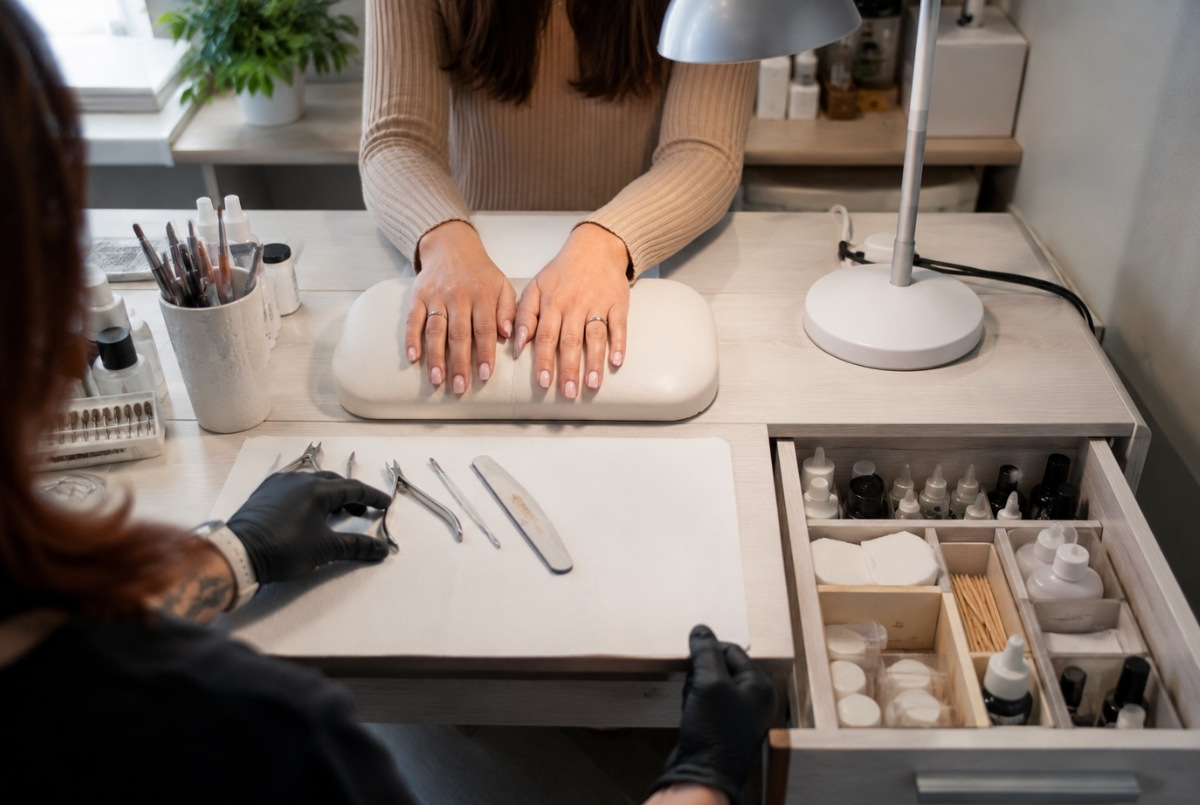
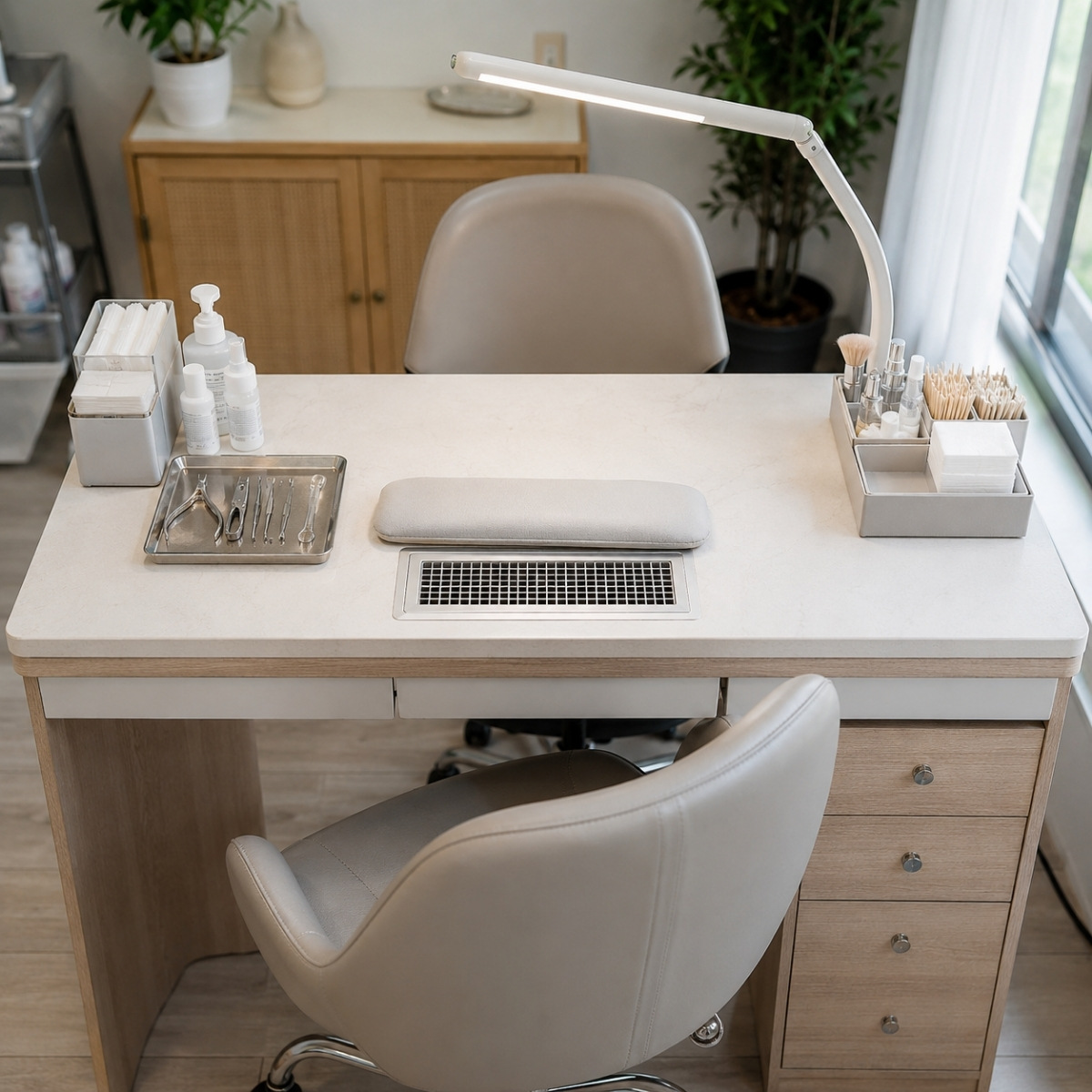
Storage is also part of maintaining proper sanitation. A functional desk for nail technician services with enclosed drawers or separate storage areas can provide designated space for reusable implements after they have been properly cleaned and disinfected. Under the Georgia State Board of Cosmetology and Barbers facility and sanitation rules, properly processed implements must be stored in a clean, closed, airtight drawer or container designated for clean implements, while used implements must remain separated until the required cleaning and disinfection process has been completed. Single-use materials must also remain clean before use and be discarded as required after use. If you are still putting together your professional equipment, our guide to core nail procedures and essential professional tools can help you understand what belongs in a practical starter setup.
Your choice of nail technician table should also reflect where and how you provide services. A permanent salon station may offer greater stability and built-in storage, while technicians performing mobile appointments, bridal services, or temporary events may prefer a portable folding table that still provides a secure working surface. Regardless of the style, the table should provide adequate room for comfortable client positioning without forcing frequently used equipment outside your natural reach.
Manage Dust, Vapors, and Chemical Exposure Properly
Professional nail services can generate filing dust while also involving polishes, adhesives, primers, removers, and other products that may release chemical vapors. Exposure can occur through inhalation as well as through skin or eye contact, making ventilation, product handling, and exposure controls important parts of everyday salon safety.
Know What a Dust Collector Can and Cannot Do
A tabletop dust collector may help capture some particulate matter produced during filing, but its performance depends on the specific unit and should not automatically be considered equivalent to a properly designed local exhaust ventilation system. Some devices collect or filter particles before recirculating air into the room, while other systems are designed to capture contaminated air close to the source and exhaust it away from the occupied space.
Local Exhaust Ventilation, commonly called LEV, is intended to capture contaminants close to the point where they are generated. According to the CDC and NIOSH guidance for nail technicians, local exhaust controls may include downdraft ventilated tables as well as portable systems that either filter air or exhaust it outdoors. The effectiveness of any particular unit depends on factors such as system design, airflow, filter configuration, placement, and maintenance. For that reason, technicians should not assume that every extractor, whether portable or built into a table, provides the same degree of protection from chemical exposure.
Do Not Treat an N95 as Chemical Vapor Protection
Respirators and face coverings also serve different purposes. Surgical and procedure masks are not respirators and should not be considered protection against hazardous chemical vapors. A properly fitted, NIOSH-approved N95 respirator can help filter certain airborne particles generated during filing or buffing, but an N95 does not protect the wearer from hazardous chemical gases or vapors.
The OSHA nail salon chemical hazard guidance identifies effective ventilation as an important method for lowering concentrations of salon chemicals in the air. If workplace conditions require respiratory protection against a specific chemical hazard, the appropriate respirator must be selected for that particular exposure and used in accordance with applicable OSHA respiratory protection requirements.
Ventilation should also be paired with proper chemical-handling practices. OSHA and NIOSH guidance recommends keeping product containers closed when they are not in use, using properly designed dispenser containers that reduce unnecessary evaporation, maintaining ventilation equipment, reviewing Safety Data Sheets, and limiting unnecessary release of chemicals into salon air. These combined controls provide a more effective exposure-reduction strategy than relying on a face mask alone.
Understand Georgia's Source-Capture Exhaust Rules
For nail salons operating in Georgia, ventilation can also fall under building and mechanical-code requirements. Under the 2024 International Mechanical Code with Georgia Amendments, manicure and pedicure stations require source-capture systems capable of exhausting at least 50 cubic feet per minute, or CFM, for each station. The related Georgia mechanical exhaust provisions also specify that when a manicure table or pedicure station lacks a factory-installed exhaust inlet, the exhaust inlet must be located within 12 inches horizontally and vertically of the point where chemicals are applied. The required system must operate continuously while the space is occupied.
A general HVAC system or a small recirculating dust collector should therefore not automatically be treated as a replacement for code-required source-capture exhaust. Anyone opening, remodeling, or renting a nail suite should verify the applicable mechanical code, local amendments, permits, and inspection requirements with the authority responsible for enforcing building regulations in that location.
Create a Station Layout That Makes Every Appointment Easier
Efficient nail services depend heavily on repeatable organization. A thoughtfully arranged station can reduce unnecessary movement, keep electrical cords away from the main service area, and make it easier to maintain separation between different categories of tools and supplies.
Place Equipment According to How You Actually Work
Arrange your primary equipment around the sequence of your typical services rather than following a universal diagram. If you use an electric file with your dominant hand, place the control unit so the handpiece and cord move freely without crossing over the client or interfering with other equipment. Position the curing lamp where the client can comfortably move a hand in and out without disrupting your active working zone. Implements required during the current service should remain accessible without forcing repeated twisting, reaching, or leaning.
There is no reliable evidence that one specific station arrangement produces the same time savings for every technician. However, keeping frequently used items within a comfortable working area can reduce unnecessary reaching, repeated equipment adjustments, and interruptions. A consistent setup can support both efficient service flow and healthier working posture.
Separate Clean Tools, Used Implements, and Disposable Supplies
An organized nail technician setup must clearly distinguish reusable implements from items intended for one-time use. Under Georgia's sanitation regulations, reusable nonporous implements such as nail clippers, cuticle nippers, certain metal drill bits, reusable nail forms, and appropriate metal or glass files must undergo the required cleaning and disinfection process after use. Once properly processed, clean implements must be stored separately from contaminated or used implements in designated closed storage.
Items that cannot be properly disinfected must not be reused between clients. Georgia's rules identify materials such as buffers, emery boards, sleeves and sanders used with electric files, orange wood or birch wood sticks, porous foot files, and similar porous materials as single-use items that must be discarded after one use. Georgia regulations also recognize the use of an appropriate autoclave as an acceptable processing method for suitable implements, but routine nail implements are not universally required to be autoclaved or presented to every client in sealed autoclave packages. For a closer look at everyday infection-control practices, review our guide to professional nail salon hygiene and modern client aftercare.
A practical station can be divided into separate areas for properly disinfected implements, tools currently being used, disposable supplies, chemical products, and contaminated implements awaiting processing. Chemical containers should remain closed when not in use and stored according to product labels and applicable Safety Data Sheets rather than being mixed into storage intended for clean implements.
Furniture and organization also influence how clients perceive the workspace. A station that appears orderly and intentionally maintained can reinforce that sanitation and service preparation are taken seriously. Learning these habits during structured nail training can make correct setup and breakdown procedures easier to repeat once you begin working with clients professionally.
What to Consider Before Renting Your Own Nail Space
Operating from your own booth or suite can provide greater control over your business, but it also introduces additional financial and legal responsibilities. The U.S. Bureau of Labor Statistics projects employment for manicurists and pedicurists to grow 7% from 2024 through 2034. Taking advantage of career opportunities in the field requires understanding not only what a rental space costs but also what is required to operate it properly.
Inspect the Facility Before Committing to It
Before signing an agreement for a nail technician room to rent, evaluate the space's physical infrastructure. Confirm adequate electrical service and lighting for your equipment, and verify that the facility meets applicable state and local requirements for toilets, lavatory facilities, sinks or shampoo bowls, and running hot and cold water. In Georgia, facility rules include specific requirements for toilet and lavatory access, so these features should be confirmed rather than assumed. Ventilation also deserves special attention because installing compliant source-capture exhaust after construction may be more complicated than selecting a properly equipped location from the beginning.
When considering a dedicated nail technician space for rent, review the financial terms of the agreement as carefully as the physical space. Determine whether the rent includes utilities, guest Wi-Fi, laundry access, waste disposal, common-area maintenance, reception services, booking assistance, or other shared amenities. The lease should also clarify which repairs, equipment upgrades, and facility improvements are the responsibility of the property owner and which expenses belong to the renter.
Work Out Your Real Booth-Rental Expenses
Published booth-rental figures vary substantially. The ZipRecruiter booth rental overview places general estimates in a broad range of approximately $100 to $500 per week depending on factors such as location and salon arrangements. These figures should be viewed as general market estimates rather than a universal national rate because pricing can differ considerably between cities, neighborhoods, private suites, and full-service rental arrangements.
Your operating budget should extend beyond rent. Recurring fixed expenses might include insurance, software subscriptions, licenses, business registrations, marketing, and suite fees. Variable expenses may include professional products, disposable supplies, laundry, payment-processing fees, and other costs that increase as you serve more clients.
To estimate your break-even point, calculate how much each appointment contributes toward fixed expenses after subtracting the relevant variable costs associated with that service. Dividing recurring fixed expenses by your average contribution per appointment can provide an estimate of how many appointments are needed to cover those costs. Because services and expenses vary, this calculation should be based on your own pricing, product use, transaction fees, and business model rather than treated as an exact universal formula.
Separate Booth Rental From Worker Classification
According to the BLS Occupational Outlook Handbook, 28% of manicurists and pedicurists were self-employed in 2024. However, simply renting a booth does not automatically establish a worker's legal classification. The Internal Revenue Service evaluates the actual working relationship, including behavioral control, financial control, and the nature of the relationship between the parties. Workers who are properly classified as self-employed may also have responsibilities related to self-employment and estimated taxes.
Licensing requirements must be considered separately from business classification. Georgia's official nail care school curriculum establishes a complete 525-hour course of training, while the Code of Arkansas Rules for cosmetology schools prescribes a 600-hour manicure curriculum. Because states may structure school, apprenticeship, examination, reciprocity, and licensing pathways differently, prospective nail professionals should verify the requirements that specifically apply to them with the appropriate state licensing agency.
Receiving an individual professional license also does not automatically satisfy every requirement involved in opening an independent workspace. Depending on the jurisdiction and business arrangement, additional considerations may include establishment licensing, business registration, taxes, zoning, insurance, building regulations, mechanical ventilation, and restrictions written into a booth or suite agreement.
Professional Training Can Make Salon Readiness Easier
Trying to understand equipment selection, sanitation requirements, chemical exposure controls, ventilation rules, and independent business expenses all at once can be challenging for someone entering the industry. Structured nail education provides an opportunity to learn technical services alongside the professional routines that support everyday salon work.
A comprehensive training program can introduce students to nail procedures, sanitation practices, safety principles, anatomy, professional habits, and salon operations. Formal education also helps students complete the training required for their applicable licensing pathway while developing practical routines they can carry into salon employment or future independent work.
Take the Next Step Toward a Professional Nail Career
Learning how to maintain an ergonomic workstation, follow sanitation procedures, manage professional equipment, and understand workplace requirements is part of preparing for a long-term career in nail technology. Students interested in hands-on beauty education can explore the Dalton Institute enrollment process to learn more about available programs and the steps involved in getting started.
Ready to explore your options? Fill out the contact form below to connect with Dalton Institute, ask questions about training and enrollment, or arrange a campus tour.
Frequently Asked Questions
How large should a nail table be in a compact studio?
There is no single regulated table dimension that suits every nail professional. Many compact commercial tables are approximately 36 to 42 inches wide and 16 to 20 inches deep, but the right dimensions depend on your available space, equipment, ventilation configuration, and body position. Choose a surface that accommodates your curing lamp, electric file, and client hand support without forcing you to work in a prolonged forward-leaning posture.
When should the filter in a nail table extractor be changed?
Follow the maintenance instructions supplied by the equipment manufacturer because filtration systems vary. For applicable ventilated tables that use charcoal filters, OSHA's nail salon guidance recommends replacing charcoal filters at least once per month and cleaning the catch basin at least once per week. Workplaces with heavier use may require more frequent maintenance. Changing filters in a recirculating unit does not, by itself, make that device equivalent to a code-required source-capture exhaust system.
Should a new nail technician choose commission work or booth rental?
Neither arrangement is automatically the better choice for every beginner. Depending on the salon, commission-based employment may reduce certain upfront expenses and may include access to clients, products, equipment, training, or administrative support. Booth rental may provide greater control over some aspects of your business, but renters can also become responsible for rent, supplies, marketing, taxes, insurance, client acquisition, and other operating costs while remaining subject to lease terms and applicable workplace rules. Review the specific arrangement and calculate your expected expenses before deciding.
What insurance should an independent nail professional consider?
Independent nail technicians commonly consider professional liability coverage for claims connected to professional services and general liability coverage for certain injuries or property-damage incidents involving the business. The appropriate policies and coverage limits depend on the services offered, business structure, location, landlord requirements, and rental agreement. Review the terms of your lease and your specific business risks before selecting coverage.